
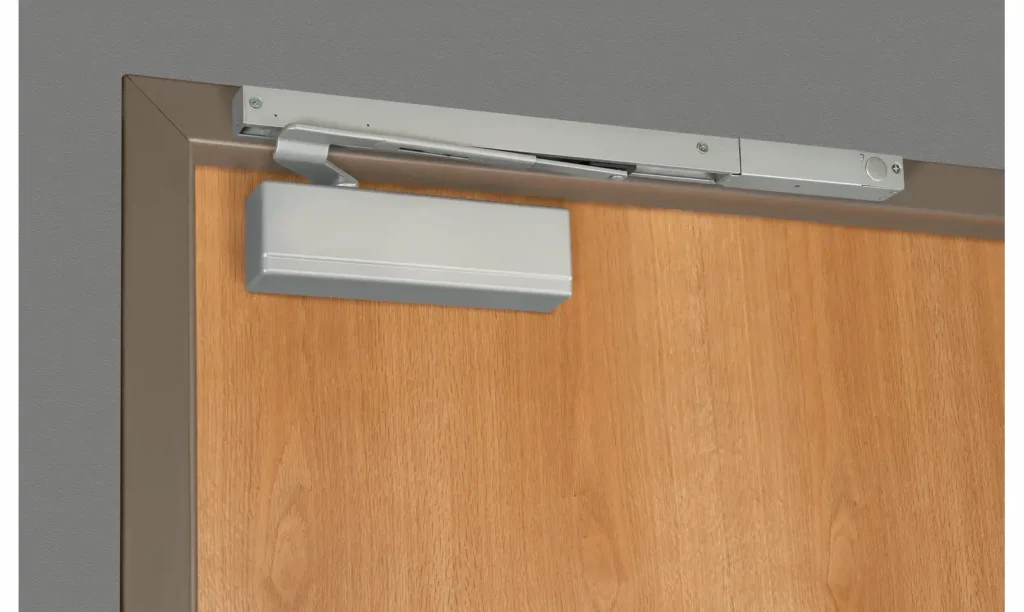
Surface or concealed overhead mounting
ANSI/BHMA A156.8-2026
Maryland, DC & Northern Virginia
Overhead stops and holders mount at the top of a door and frame. They control how far a door opens, reducing impact damage to walls, frames, closers, hinges, glass, and adjacent openings.
A stop-only unit limits swing without holding the door open. A holder adds a controlled hold-open position for normal traffic flow. These devices are common on office, healthcare, hospitality, government, education, and commercial entrances where reliable door control matters.

Limits opening travel before the door strikes walls, furniture, glass, equipment, or nearby doors.
Hold-open models keep busy non-fire-rated openings clear during deliveries, service, cleaning, and peak traffic.
Reduces repeated shock loads that can loosen hinges, damage closers, and stress frames.
King Locksmith And Doors Inc. provides commercial door hardware service for facilities throughout the Washington metropolitan area. Our team evaluates the complete opening before recommending an overhead stop or holder. We consider door size, weight, frame condition, swing direction, nearby obstructions, traffic levels, code needs, and the purpose of the opening. From a single damaged stop to multi-door upgrades, we help organizations protect their doors with practical, serviceable hardware.
The right overhead device must fit the door, frame, swing, environment, and intended use. Choosing by appearance alone can lead to loose mounting, damaged hardware, or unsafe hold-open conditions.
Heavy doors place greater force on the arm, track, fasteners, and frame. Hollow-metal doors, solid-core wood doors, glass doors, and exterior doors may require heavy-duty or extra-heavy-duty hardware.
Door width also matters. A wider door creates more leverage when it reaches the stop position, especially in windy exterior or vestibule locations. Match the device rating to the actual opening, not a rough estimate.
Surface-mounted overhead stops and holders are visible, accessible, and generally easier to inspect and service. They work well where appearance is secondary and ongoing maintenance access is important.
Concealed models hide more of the hardware within the door and frame. They can provide a cleaner look, but installation may require door and frame preparation.
Select the opening angle based on what the door must clear. The door should open far enough for traffic, carts, wheelchairs, and deliveries without contacting walls, glass sidelites, casework, equipment, or another door.
A properly adjusted stop protects the opening before contact occurs. Do not rely on a closer arm, hinge, wall bumper, or improvised block to control an over-opening door.
Choose a stop-only model when the door should always close freely after use. Choose a holder when staff need to keep an appropriate non-fire-rated door open for daily circulation, deliveries, housekeeping, or events.
The hold-open method should suit the opening. Mechanical holders can be useful in the right application, but the door’s code status must always be reviewed first.
Fire-rated doors must be able to close and latch during an alarm or fire event. A mechanical hold-open device may not be appropriate for a rated opening because it can prevent automatic closing.
Where an approved hold-open function is required, the solution may need to release automatically through the building fire-alarm system. King Locksmith and Doors Inc. can assess the opening before recommending hardware.
Overhead hardware controls the swing from above, keeping the floor area clear. Floor or wall stops can work in some openings, but they may create clearance, cleaning, impact, or appearance concerns.
Consideration
Overhead Stops and Holders
Floor or Wall Stops
Keeps walking surface fully unobstructed
Can obstruct cleaning and foot traffic
Controls movement at door top
Applies force near door bottom
Available in concealed mounting options
Often remains visible at floor
Helps protect frame and adjacent surfaces
May stress lower door area
Supports controlled hold-open operation
Offers limited hold-open versatility
Overhead hardware often fails because the original device was undersized, improperly mounted, poorly adjusted, or exposed to forces beyond its intended use.
We inspect the door, frame, swing path, nearby obstructions, existing hardware, and operating conditions before recommending a solution.
We install properly sized overhead stops and holders with suitable mounting methods for the door and frame construction.
We replace worn, bent, loose, obsolete, or damaged overhead hardware with compatible commercial-grade components for the opening.
We adjust holder positions and swing limits so doors support traffic flow without striking surrounding building surfaces.
We address damaged fastener locations, loose hardware mounting, and related door or frame issues affecting stop performance.
We standardize overhead door control hardware across offices, facilities, campuses, hotels, healthcare sites, and government buildings.
Protect your commercial doors with properly selected overhead stops and holders installed for the opening’s real operating conditions.